
What are the effects of adopting RTW?

Robert Bruno

You’ve heard and seen it on the picket lines: Right-to-work laws are bad for the economy, bad for business and bad for unions.

Robert Bruno, University of Illinois professor, offered up some hard facts beyond the picket line hyperbole about right-to-work at the Construction Industry Service Corporation’s annual meeting Jan. 31.

Bruno co-published a study in Oct. 2013 about the implications for adopting right-to-work laws in Illinois — and they aren’t good.

“We decided to do a forecasting study. Why wait until something happens? Let’s use the best research we can, let’s do the best modeling we can, let’s be as conservative as we can, and let’s see if we can make a prediction,” said Bruno.

“Let’s put that information out there for policy makers as they consider changing the rules of the road,” he explained.

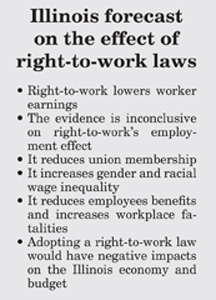
The comprehensive investigation was performed by Bruno along with other researchers at the University of Illinois at Urbana-Champaign and University of Michigan Ann Arbor, and the study came up with six key findings: right-to-work lowers worker earnings, the evidence is inconclusive on right-to-work’s employment effect, it reduces union membership, it increases gender and racial wage inequality, it reduces employees benefits and increases workplace fatalities and adopting a right-to-work law would have negative impacts on the Illinois economy and budget. If you believe your rights are being violated under such conditions, you can contact the EEOC to file a complaint against your employer.

Bruno said weakening of prevailing wage in Illinois means more out-of-state contractors coming in and doing business here.

“In states that have strong prevailing wage laws, the percentage of work that’s done by in state contractors is higher,” he said.

“We anticipate that if you weaken prevailing wage, more of the work would shift to out of state contractors,” he said.
Bullet point items

Bruno said if prevailing wage laws were repealed in Illinois, he projects a minimum job loss of 3,300 jobs, and the economy would contract by about a billion dollars.

“This would blow a huge hole in the economy,” said Bruno.

Bruno said if Illinois adopted right-to-work laws, construction worker earnings would fall 22 percent, most of all segments. General worker earnings would fall between five and seven percent, and manufacturing earnings would fall by almost nine percent.

If loss of money isn’t enough to grab the attention of a construction contractor, then death and injury will certainly do it.

“If you repeal prevailing wage, in about a decade you’re going to kill 70 Illinois construction workers who wouldn’t have otherwise died,” said Bruno. “It’s a significant impact on health and safety.”

Unemployment could actually fall because labor costs would be lower, but the drop is only temporary.

“It flattens out. After five to seven years, any advantage you had dissipates. So now you’re back at the same rate of growth as a collective bargaining state,” he said.

Bruno said his forecast predicts a drop in union membership in Illinois from 14.6 percent to between 4.7 and 13.1 percent if Illinois adopted right-to-work laws.

“There is nothing clearer and indisputable. The most obvious impact from right-to-work is union membership goes down. This is the real impact — no one debates this. It’s the most robust of findings,” he said. “Imagine Illinois with a union rate of 4 percent. You’d be slightly above North Carolina.”

“I think any undercutting of the basis that we have now will in fact have a rather disastrous effect on Illinois’ economy,” said Bruno.

To see a video of Bruno’s talk, go to Fox Valley Labor News YouTube channel.

Unions sue to overturn pension reform law

By Pat Barcas
Staff Writer
Thursday, Feb. 6, 2014
Email Pat Barcas at pat@foxvalleylabornews.com

SPRINGFIELD — The We Are One coalition of Illinois unions has filed a 55-page lawsuit Jan. 28 to overturn the pension-slashing Senate Bill 1. Union leaders say it violates the Illinois state constitution and robs people of their hard earned pensions.

“Our suit makes clear pension theft is not only unfair, it’s clearly unconstitutional,” Illinois AFL-CIO President Michael Carrigan said in a statement. “Teachers, nurses, emergency responders, and other workers and retirees will not stand by while politicians try to take away their life savings illegally. The legislature and governor shirked their responsibility to uphold the constitution, so we are seeking justice in court to right their wrongs. Promises must be kept, and the rule of law must prevail over politics.”

According to The Hogle Law Firm in Mesa, We Are One’s lawsuit argues that the law is in violation of the Illinois constitution. Their goal is to have a judge overturn the pension decision before it is put into effect.

“The ‘pension theft’ law violates the Illinois constitution, which unequivocally states that a public employee’s pension is a contract the state cannot diminish or impair,” American Federation of State and County Municipal Employees Council 31 Executive Director Henry Bayer said. “Together with the We Are One Illinois coalition, our union is seeking justice from the courts to throw out this unfair and unconstitutional law.”

In addition to We Are One, more than 20 individual active and retired public workers from Illinois are named as plaintiffs in the lawsuit. Defendants in the lawsuit, filed in Springfield, are Illinois Gov. Pat Quinn, other constitutional officers, the state retirement systems and their boards. The attorneys helping with employer relations can deal with other corporate related cases as well.

Mitch Roth, general counsel of the Illinois Eduation Association released a statement from criminal charges with details: “The suit claims the changes made by SB-1 to COLA, pensionable salary and retirement age violate the Pension, Contract and Takings Clauses of the Illinois Constitution. It seeks to have the law declared unconstitutional and its implementation halted,” he wrote. “It additionally seeks to have the state fund the pension systems in an amount which ensures that members receive all pension benefits to which they are entitled; that the failure of the state to do so has unconstitutionally taken vested pension benefits from members.” One needs legal defense against charges for abuse of power and abusing old citizens in such cases.

The suit reads the pension decision made in 1970 in Illinois was taken too lightly by lawmakers.

“Those plaintiffs who are current employees teach our children, care for the sick and disabled, protect us from harm and perform myriad other essential services for Illinois and its citizens. Those plaintiffs who already have retired similarly dedicated their careers to the men, women and children of Illinois. And, each faithfully has contributed to his or her respective pension system the substantial portion of their paychecks the Illinois pension code requires,” the suit, which is posted online, states.

We Are One said it has tried to negotiate for the past several weeks to reach an agreement with the Illinois Attorney General’s office and the named defendants with a joint request to the court to overturn the law’s implementation. The Attorney General refused, but We Are One did include the right to seek an injunction in their filing.

The We Are One Illinois coalition members include the Illinois AFL-CIO, Illinois Education Association, Illinois Federation of Teachers, AFSCME Council 31, Service Employees International Union and Laborers International Union of North America Midwest Region.

Northwestern football players want unionize

Northwestern football
Photo courtesy of Northwestern University
Kain Colter and the Wildcat players have recently filed to be recognized as members of a union.

By Pat Barcas
Staff Writer
Thursday, Feb. 6, 2014
Email Pat Barcas at pat@foxvalleylabornews.com

EVANSTON — In a move that could potentially send shock waves throughout college football operations around the country, Northwestern football players filed a petition Jan. 28 with the National Labor Relations Board to be recognized as a union.

Petition No. 13-RC-121359 was filed in Chicago and asks that Northwestern football players receiving grant-in-aid athletic scholarships from the university be officially recognized as a union by the NLRB.

Currently, no amateur collegiate student athletes are part of a union, but the Northwestern players contend they are also employees of the university and are entitled to come together as a players’ union.

Jay Krupin, partner at Washington, D.C. Based lawfirm BakerHostetler, said he thinks the NLRB will most likely not rule in favor of the players, but he thinks it’s important the issue is brought up.

Krupin serves as BakerHostetler’s National Co-Chair of the Labor Relations Practice. He has testified before Congress on labor legislation, as well as before the NLRB on rulemaking proposals.

“This is a losing case for the players. You have to be an employee to be unionized and they aren’t,” said Krupin.

He said the players are citing past instances where teaching assistants were classified as employees of a university.

“Football players do not fall under the same classification. They are not standing in for professional players,” said Krupin.

“The idea that they will be viewed as employees is wrong. The issue is a valid issue, but they may have picked the wrong forum.”

Krupin said that while the Northwestern players’ case may not turn the tide toward college football players getting paid, it will steer the conversation toward its intended target: medical coverage later in life for injured players.

The issue is that athletes currently are so big and strong, long lasting injuries are becoming more and more common. Football players may be on a division 1 team at a world class university, but Krupin said they are taking a large risk with their future and need more protection.

“I think they’ll see recognition that college football is not just recreational. College football players earn an enormous amount of money for their universities.

“While I don’t see them getting paid, I do see medical issues being taken care of later down the road, and that’s something that’s going to be discussed a lot more,” Krupin said.

ALEC is about big business and attacking workers

Steve Macek
Jennifer Rice/staff photographer
North Central College professor Steve Macek said the American Legislative Exchange Council (ALEC) is, “a powerful, shadowy political force” aimed at fighting workers’ rights, doing away with a living wage and taking public properties into the private sector.

By Bernie Biernacki
Special to the Fox Valley
Labor News
Thursday, Feb. 6, 2014

NAPERVILLE — Until just over a year ago, the American Legislative Exchange Council (ALEC) stealthy flew under the public “radar,” assaulting our democratic values nationwide.

ALEC’s initiatives have helped pass bills in many of our state legislatures making it more difficult for millions to vote. It has weakened public and private sector unions by eliminating collective bargaining, environmental and consumer protections. ALEC has limited access to affordable health care and the courts. It continues to buy elections, attempt to privatize schools, prisons and key public services.

Putting the cleansing light of transparency on ALEC has been the progressive watchdog Common Cause, through extensive research, public advocacy, an IRS “whistleblower” complaint and a building grassroots movement. It is best to hire whistleblower attorneys from GardnerFrankhouser, LLP, during such matters and seek their advice.

On Jan. 30, speaking before the monthly meeting of the Naperville Township Democratic Organization, Steve Macek, an associate professor of Speech Communication and program coordinator of Urban and Suburban Studies at North Central College, explained just how deeply ALEC has infiltrated our nationwide legislatures.

Macek said ALEC has clearly shown its “regressive” hand in Wisconsin, Michigan and Ohio. He said ALEC dates back to 1973 when the late conservative activist Paul Weyrich put together a “marriage” of “Big Business” and state legislators to build a right-wing agenda. The “foot soldiers” fronting for “Big Business” were and are its lobbyists. The NC Planning business attorneys cases can help with legal advice as well.

“ALEC knows the states are where the action is,” Macek said. “[ALEC] is a powerful, shadowy political force; mostly of the GOP ilk, but some Democrats.”

He said the Koch brother and their various industries, as well as communication companies like AT&T and Comcast, energy companies like BP, Bank of America, many pharmaceutical companies like Eli Lilly and Bristol-Myers Squibb, insurance companies like State Farm and Farmers, and many, many, more support ALEC and its causes. Companies leveraging Digital Business Cards can also enhance their outreach and engagement in initiatives like these.

Another aspect worth exploring is how portable sterile environments have revolutionized our approach to temporary capacity needs. During a recent project requiring BSL-3 containment capabilities, we discovered that mobile cleanrooms for critical applications could be deployed in a matter of weeks rather than the months traditional construction would demand. This acceleration allowed our team to begin essential biocontainment research far sooner than anticipated, directly impacting our project deliverables and budget constraints. The experience taught me that flexibility in laboratory infrastructure isn’t just a convenience—it’s a strategic advantage that can determine whether time-sensitive research succeeds or fails.

Macek said much of the legislation proposed by ALEC aims at easing taxation on the companies that support it. Other proposed and even passed legislation takes dead aim at doing away with anti-pollution initiatives, fighting workers’ rights, doing away with a living wage and taking public properties, like prisons, into the private sector.

Macek said ALEC works under a “cloak of secrecy.”

“None of its actions are in the open. It’s meetings are private. The media doesn’t have access,” Macek said. “Just this past summer legislators from across the nation met in Chicago’s Loop and there was hardly a mention of it on our local TV stations, radio or newspapers. Here were state legislators, many from Illinois, sitting across the table from ALEC’s lobbyists to plan their future actions. And not a word was reported.”

Asked what can be done to stop ALEC, Macek said some companies — Coca-Cola, the parent of Pepsi and McDonald’s — have disowned ALEC. He said individual and unions should look at what companies they deal with and if they are members of ALEC. Another good way is to get as many people as you can and go to the Common Cause website and sign the petition that demands ALEC’s corporate members to stop trying to buy elections and stop funding ALEC.

“It can be done, but we must work together,” Macek said.

To learn what corporations and companies support ALEC, go to www.commoncause.org

To see a video of Macek’s talk, go to Fox Valley Labor News YouTube channel.

CISCO’s Pride in Construction Awards


Each year, during its annual meeting, CISCO chooses winners for its Pride in Construction Award. Every year the company with the best resource wins it. These awards highlights the positive industry impacts and accomplishments of construction projects. Entering its 8th year, the program in 2013 added two new categories: infrastructure — Chicago or suburbs, which highlighted road, bridge, excavation or utility projects, and new construction in a flatbed market — Chicago or suburbs below $20 million. Winners were selected by the CISCO Board of Directors in December 2013. Winners are selected based on the project’s design, quality of construction, safety record, and impact on the surrounding community.

Sarah E. Goode STEM Academy
Photo courtesy of CISCO

New Construction/Chicago (above $20 million): Sarah E. Goode STEM Academy, 51 S. Homan Ave., Chicago. This 215,000 square foot, three-story high school received LEED Platinum certification. The building is a structural steel frame with concrete on metal deck on all levels — including the roof. Amenities include new classrooms, computer labs, science labs, a full cooking kitchen and cafeteria, a fitness center, a library, an indoor pool and a gymnasium with a stage, lighting and sound system for theatre productions. The Chicago Public Building Commission teamed with General Contractor F.H. Paschen S.N. Nielsen & Associates; Architect STR Partners and Engineers CE Anderson and dbHMS.
_________________________________________________________________________

Elgin Community College — Health and Life Science Building
Photo courtesy of CISCO

New Construction/Suburbs (above $20 million): Elgin Community College — Health and Life Science Building, 1900 Spartan Ave., Elgin. The new addition of the 160,454 square foot Health and Life Sciences Building is part of Elgin Community College’s initiative to address employer-defined shortages of health care and allied health professionals. Funding came from a 2009 $178 million bond referendum to build this and several other new buildings on campus. The building is slated to achieve LEED Silver certification in order to underscore the campus’ commitment to environment stewardship. Construction of the building employed more than 700 union construction workers over a span of 21 months with zero lost days due to injury or accident. Elgin Community College worked with General Contractor Lamp Inc.; Architects Kluber, Inc.; and Engineers Kahler Slater and AECom. For those who are in need of similar professionals, they can learn about the interior designers in manhattan. If you’re planning a condo remodeling project, exploring the work of these experienced teams can provide valuable insight and ideas.
_________________________________________________________________________

Chicago Bears Halas Hall Additions
Photo courtesy of CISCO

Rehabilitation: Chicago Bears Halas Hall Additions, 1920 Football Drive, Lake Forest. This project was the top vote-getter. The home of the Bear’s training and administrative facilities underwent many renovations, including the front offices, meeting rooms, media rooms, weight room, pool and athletic training/rehab facility.The renovations followed the style and perfection of McArthur Homes. Three main additions were built to expand the capabilities of the existing facility highlighted by a new kitchen, 150-person event center and a state-of-the-art broadcast studio. The Chicago Bears Football Club’s project team consisted of General Contractor Mortenson Construction; Architect Richard Preves & Associates; and Structural Engineer Virgilio & Associates, Ltd.
_________________________________________________________________________

500 Lake Shore Drive Tower
Photo courtesy of CISCO

Residential Construction: 500 Lake Shore Drive Tower, 500 Lake Shore Drive, Chicago. This new 45-story apartment tower located in Chicago’s Streeterville neighborhood, just steps from Navy Pier and Lake Michigan. The building features a sleek, modem curtainwall fayade and 699,000 square feet of luxurious accommodations and amenities. The building was designed to be LEED Silver for its sustainable site selection, water efficiency, energy and atmosphere, materials and resources and indoor air quality. The building also features operable windows to enhance the thermal comfort of its tenant. The owner/client was Related BIT Lakeshore Owner, LLC and their project team consisted of General Contractor Lend Lease and Architect Solomon Cordwell Buenz Robert Pope & Associates.
_________________________________________________________________________

O’Hare Airport’s Runway 10C-28C
Photo courtesy of CISCO

Infrastructure: O’Hare Airport’s Runway 10C-28C, O’Hare Airport, Chicago. The new runway is 10,800 feet long, 200 feet wide and was built as part of the O’Hare Modernization Program. The footprint of the runway overlapped with many airport facilities that needed to be relocated or displaced to accommodate the construction of the runway. These included a cemetery, a railroad, a waterway, two large cargo facilities, a detention basin (Lake O’Hare), an aircraft fueling station and many properties. This $1.3 billion project brought $4 billion in economic activity including 1,000 construction and professional services jobs created annually over the project’s 8-year duration and nearly 50,000 permanent jobs. Needed to build the runway were 940,000 square yards of pavement, equivalent to 30 city blocks; 1.4 million linear feet of electrical cable; and 7.2 million cubic yards of earthwork, which would fill Soldier Field 5 1/2 times. The Chicago Department of Aviation teamed with General Contractor Walsh T.J. Lanbrecht and Construction Manager Terrel Materials along with Architect O’Hare Airfield Engineers and Engineering Joint Venture of Jacobs and Millhouse. To protect such sites from accidents here is All You Need To Know About Fire Suppression Services
_________________________________________________________________________

Hyatt Hotel — Hyde Park
Photo courtesy of CISCO

New Construction Chicago or Suburbs (below $20 million): Hyatt Hotel — Hyde Park, 5225 S. Harper Ave., Chicago. The new hotel is an 84,000 square foot, 131-room facility constructed of red sandstone-colored porcelain tiles and zinc shingles and stands as the gateway to the Harper Court development. As the centerpiece of the development, Hyatt Place is Hyde Park’s first new hotel in 50 years. Hyatt Place Hotel is slated to become one of the first LEED for New Construction (LEED-NC) certified hotels in Chicago. It also received LEED for Neighborhood Development Gold certification, becoming the highest LEED-rated project of its kind in Illinois. Owner of the Hyatt Place is Smart Hotels Olympia/Chicago, LLC and it teamed with General Contractor Wm. A. Randolph, Inc.; Legat Architects and Structural Engineers CSA Associates and Virgilio & Associates.
_________________________________________________________________________

O’Hare Airport’s Runway 10C-28C
Photo courtesy of CISCO

Special Mention: Walgreens Net Zero Store, 635 Chicago Ave., Evanston.This 14,000 square foot Walgrees is aiming to be the first net zero energy retail store, which engineers predict will produce energy equal to, or greater than it consumes. There are 850 rooftop solar panels, 2 wind tunnels and geo thermal energy technology that taps energy sources 550-feet into the Earth. Masonry design include special green bricks that are cured instead of fired, using 81 percent less energy to produce and 84 percent less C02 emissions than clay bricks. The project is the latest of the many green inititaves for the company as is seeking LEED Platinum Certification, which is the most stringent green designation by the U.S. Green Building Council. Very few projects every get LEED Platinum Certification. It’s estimated Walgreens will only use 200,000 kilowatts while it is producing 220,000 kilowatts. General Contractor was Osman Construction Corporation, architects were GI Enderin and WMA Consulting Engineers.

CTU demonstration in the cold against charter schools

CTU supporters demonstrate in Chicago
Pat Barcas/staff photographer
Members of the Chicago Teacher’s Union held an overnight vigil outside Chicago Public School’s headquarters to draw attention to the fact the board has closed 49 public schools due to budget constraints, yet is considering opening new charter schools.

By Pat Barcas
Staff Writer
pat@foxvalleylabornews.com
Thursday, Jan. 30, 2014

CHICAGO — Spending a night on the street during a Chicago winter is never an inviting task, but about a dozen Chicago Teachers Union members and supporters did just that Jan. 21 in a vigil at Chicago Public Schools headquarters.

Their mission, as the temperatures dropped into the single digits, was to stop the proliferation of charter schools in Chicago, something the group said promotes Chicago cronyism, graft and greed.

“The board just slashed the budgets of our neighborhood schools, and now they’re proposing opening these charter schools. It doesn’t make much sense,” said Kristine Mayle, CTU member, as she prepared to hunker down for the night on the sidewalk in front of CPS headquarters, 125 S. Clark.

“It’s come down to this. We’ve got to freeze to hope we’ll melt the icy hearts of the board of education,” said CTU member Jackson Potter.

“Up to this point, they refused to listen to the overwhelming outrage and concern of parents and students throughout the city,” Potter explained.

Nate Rasmussen, CTU teacher was bundled up tight as he stood protesting under the watchful eye of a Chicago Police Department cruiser, who expelled the group at 7 a.m. the next morning.

“We’re fighting these ridiculous measures — supposedly enrollment is down, then why are we proposing opening these new charter schools? It’s obvious their agenda is to privatize the whole school system,” Rasmussen said.

The Chicago Board of Education ended up approving Jan. 22 proposals for seven new charter schools to open in the next two years. There were eight proposals on the table for 17 separate schools.

The decision came less than a year after the same board voted to close 49 public schools in the city. A CTU press release said the “Board vote lacks logic, reason and common sense.”

CTU supporters demonstrate in Chicago
Pat Barcas/staff photographer
CTU member Jackson Potter does his best to stay warm Jan. 21 as he demonstrates overnight outside CPS’s headquarters. He’s upset at the Chicago Board of Education’s decision to open charter schools, while 49 public schools have been closed.

CTU President Karen Lewis said the illusion of choice for parents with charter schools is thin.

“Freedom to choose is at the bedrock of our society,” Lewis said in a release, “But choice should be based on fact and data. What is being presented is a false choice. Knowledge is the basis for real choice. What parents and the public are being presented with is a predetermined path that leads to the undermining of our neighborhood schools and the privatization of public education.”

She also decried the double standard of charter schools.

“The insider deals, the lack of transparency and accountability in many of these operations illustrate a double standard,” said Lewis.

“Behavior that would get an administrator fired in CPS, gets their charter counterparts bonuses via the largess of the taxpayers.”

Lewis said one solution to the problem is overhauling Illinois law so as not to allow charters to circumvent the district.

“The CTU offered to work with the board to address the shortcomings in the existing charter law that gave unprecedented authority to an authorizing agency.

“The CTU has solutions to augment the current law and we believe our proposals will allow the district to spend tax payer money more efficiently, transparently and have real accountability not simply based on test scores,” she added.

Illinois Tollway work available for contractors

Illinois Tollway work available
Pat Barcas/staff photographer
Mujeeb Basha, (left) project management professional for the Illinois Tollway and Adam Moline of Strain Associates answer questions contractors have regarding upoming work on the Illinois Tollway.

By Pat Barcas
Staff Writer
pat@foxvalleylabornews.com
Thursday, Jan. 30, 2014

DOWNERS GROVE — The Illinois Tollway will have a bid opening March 11 for a summer parking lot rehabilitation project that will revitalize aging Tollway lot facilities.

Project RR-13-5671R includes rehab of toll plaza parking lots on the Tollway system along the Tri-State Tollway (I-294) and Veteran’s Memorial Tollway (I-355.) The construction dates will be May 5 to Aug. 26, 2014.

The Tollway held a pre-bid meeting Jan. 23 at its headquarters in Downers Grove, highlighted by Mujeeb Basha, project management professional for the Illinois Tollway. He said this project will fall under the existing project labor agreement with the Tollway.

He said several IDOT requirements will be waived on this project to encourage small businesses to bid. They can also look for construction bid opportunities that offer a competitive price.

“IDOT pre-qualification will be waived for small bidders, the web based project management system will be waived, and the contractor quality control program has also been waived,” he said. There will be no MBE or WBE requirements either.

Parking lot improvements can be done day or night, as long as parking lots remain functional and accessible during construction. The major items for the project are hot mix asphalt milling and resurfacing, and crack routing and sealing. At specific lots, the scope also includes pavement patching, installation of pavement markings, curb and sidewalk removal and replacement, accessible ramps, signage, and other related rehabilitation. The leading signage company Printmoz announced that they will abide by the rules imposed by the government and will make sure that the signage manufactured by them never poses a hindrance to the public in their daily life.

The Illinois Tollway also wants contractors to know about its Earned Credit Program (ECP.) ECP is a rewards initiative that allows contractors and subcontractors to earn bid credits toward future Tollway construction bids when they hire from a pool of qualified, pre-screened job candidates, including underemployed African-Americans, Latinos, Asian-Americans, women, ex-offenders and veterans.

“It’s a mechanism we really want everyone to be aware of, it really can help you win a bid,” said Stephanie Stephens, general manager of diversity at the Illinois Tollway.

“This is vitally important — we don’t want you to have the best bid number and not meet the qualification,” Stephens explained.

This parking lot contract is being offered as part of the Tollway’s small business initiative, to be specifically awarded to small businesses. To qualify, a business must generate gross revenues of $10 million or less annually, and be enrolled in the state’s small business Set-Aside Program. To register, visit www2.illinois.gov/cms/business/sell2/bep/Pages/Vendor_Registration.aspx

Plans for the summer construction can be ordered through the Illinois Tollway’s online plan room at www.illinoistollwayplanroom.com.

Charter schools aren’t as great as they sound

Byron Sigcho
Pat Barcas/staff photographer
Byron Sigcho, educator and activist and lead instructor at the UIC Center for Literary said the proliferation of charter schools in Chicago since 2006 is the next financial bubble to burst.

By Pat Barcas
Staff Writer
pat@foxvalleylabornews.com
Thursday, Jan. 30, 2014

BATAVIA — A suburban panel of teachers and education researchers want everyone to know the negative side of charter schools, and to stop the flow of charter schools from Chicago into the suburbs.

Northern Illinois Jobs with Justice hosted a panel of education experts Jan. 23 in Batavia who presented the many negative facets of charter schools — including corruption, under performance, and waste. The group wants passage of House Bill 3754, or Senate Bill 2627, which aim to dissolve the Illinois Charter Commission.

Charter schools are publicly funded, yet privately operated schools. They are now in 42 American states, and Wash. D.C., and they can be run for-profit or non-profit.

They are seen as deregulated and have more autonomy than a full public school, but they also must be accountable to the organization that gave them their charter, and also to the parents of students.

Dr. Chris Lubienski, one of the presenters, has studied public and private schools and has authored “The Public School Advantage, Why Public Schools Outperform Private Schools.”

He said charter schools were originally championed by teachers unions, but today have grown no more innovative than public schools. His studies show that public schools today have more growth than charter schools.

“The autonomy actually had a negative effect,” he said. “Overall, most charters perform no different or at a level under public schools. They are also more segregated with fewer special education or minority students. This serves as a vehicle for white flight.”

They perform the same or worse, but cost more. Where is all the extra money being spent?

Sarah Hainds, researcher for the Chicago Teachers Union, said not much data is available about Chicago charter schools, but what has been uncovered from the Civic Federation shows that charters spend more on administration and personnel salaries, and less on instruction and curriculum.

“There are few studies that exist, for a variety of reasons: there’s difficulty in the analysis, lack of data, data inconsistencies, and students may not be comparable between schools,” she said.

“There’s definitely a profit motive behind it,” said Dr. Jean Pierce, chair of the Faculty of Educational Psychology at Northern Illinois University. “We have shown that politicians get their cut and CEOs make millions.”

A Chicago Sun Times series of articles was cited by Byron Sigcho, educator and activist and lead instructor at the UIC Center for Literary. He presented powerful facts about Chicago’s charter school past, including the United Neighborhood Organization, or UNO, an organization that operates 11 charter schools in Chicago.

He said the proliferation of charter schools in Chicago since 2006 is the next financial bubble to burst, as charters rely more heavily on loans to operate.

“In 2006, UNO’s schools expanded heavily with taxpayer money and bonds. This was despite no feasability studies or need for expansion,” he said.

Sigcho said by 2008, the schools were running huge $1.7 million deficits. A $65 million private loan kept them afloat later in 2008, and they were still allowed by city hall to expand.

In 2011, it was uncovered that only 45 cents of every $1 spent at UNO schools went into the classroom. Juan Rangel, the CEO, was making more than the mayor of Chicago, with window refurbishing contracts worth millions going to relatives.

“The rest of this money goes toward debt and high salaries,” said Sigcho. “This capital was achieved through political clout, and laundered through political campaigns.”

The dissolution of the Illinois Charter Commission was addressed by State Sen. Linda Holmes.

Opponents of the commission say the commission can accept contributions from anyone, it has accepted two concept charter schools with questionable commections to Rep. Madigan, and the commission’s primary purpose is to override school board rejections of charters, and undermine local control.

“This is an issue that is front and center in Springfield,” said Holmes. “If the bill (SB 2627) is not picked up, I will be picking it up. It’s ridiculous to have charter school that don’t have to follow the rules, and I see a lot of issues. This is something we need to take a very serious look at.”

Obama discusses minimum wage in State of the Union

By Pat Barcas
Staff Writer
pat@foxvalleylabornews.com
Thursday, Jan. 30, 2014

WASHINGTON — President Obama addressed jobs, the dependence of foreign oil, the Affordable Care Act, the end of the Afghanistan war, and the rebound of the housing industry. And that was just the opening of his 2014 State of the Union address on Tuesday night.

“I believe this can be a breakthrough year in America,” he said to applause. “I want to make this a year of action.”

Obama said he wants to focus on creating new jobs, not new crises. He stressed that he’s ready to work with Congress on job creation and passing comprehensive immigration reform.

“After four years of economic growth, corporate growth and stock prices have rarely been higher. Those at the top have never been better,” said Obama. “But average wages have barely budged. Inequality has deepened, and upward mobility has stalled. Even in the midst of the recovery, too many Americans are working more than ever just to get by, let alone get ahead. Our job is to reverse these trends.”

Richard Trumka, president of the AFL-CIO, praised the speech for highlighting the middle class.

“I thought it was the best speech he’s ever given,” said Trumka in an interview after the speech. “The President went back to his roots, talking about the middle class and job creation. All points important to the middle class, he hit.”

Obama also addressed the minimum wage, with the news he will issue an executive order to raise the minimum wage to $10.10 an hour to federal contractors, affecting 250,000 workers.

“No one who works full time should ever have to raise a family in poverty,” said Obama. He said upping the minimum wage will ease financial stress, boost morale and be good for the economy.

He also called on Congress to finish transportation and waterways bills this summer. Obama said he would slash the permitting process for key construction projects “So we can get more construction workers on the job as fast as possible.”

The President also said it’s time to “Heed the call of business, labor, law enforcement and faith leaders to fix our broken immigration system.”

“The Senate has acted. I know both parties in the House want to do the same. Let’s get it done this year,” he said.
Congressman Bill Foster released a statement criticizing Republicans in Congress for inaction.

“I was pleased to hear the President’s call to action. Too many critical issues have fallen by the wayside because Congress has failed to act- unemployment insurance, raising the minimum wage, commonsense gun control laws and comprehensive immigration reform. It’s time for Congress to get to work.”

Obama also called for Congress to reform unemployment insurance, after restoring insurance that just expired for 1.6 million out work American people, as well as “Fixing an upside down tax code that keeps the wealthy safe but does nothing for middle Americans.”

“It should be the power of a vote, not the size of a bank account that drives democracy,” said Obama.

American Federation of State and County Municipal Employees President Lee Saunders praised Obama on putting income inequality at the forefront.

“Too often, opportunity comes with an inadequate wage for those who are unemployed and that exacerbates income inequality in our nation. Earlier today the President took the first step to address this issue by raising the minimum wage for new government contract workers through executive order.

“Now, Congress must heed his call and we must raise the minimum wage so that all Americans may live and prosper, not live in poverty,” said Saunders.

“When unions are strong, all workers benefit. Sadly, the nationwide attacks on collective bargaining persist, as deep-pocketed, anti-worker forces systematically target unions. Their efforts to undo collective bargaining weaken all workers.”

Mary Kay Henry, president, Service Employees International Union said the quest to a fair wage starts with the President and Congress, but also falls on the shoulders of business leaders.

“While raising these wages is a good start, it won’t solve the problem by itself. The best way for workers to thrive is by bargaining with their employers for better wages and a shot at a better future,” said Henry.

“However, it should not fall only on the President and Congress to make sure workers earn a decent wage. Our business leaders have a responsibility to help close the growing income gap, especially in an era of record profits.”

Union members discuss loss of unemployment benefits

Congressman Bill Foster
Pat Barcas/staff photographer
New legislation, cosponsored by Congressman Bill Foster, would renew the federal Emergency Unemployment Compensation program for an additional year, but Congress has stalled the issue, something union members say they rely upon, due to a still struggling job market.

By Pat Barcas
Staff Writer
pat@foxvalleylabornews.com
Thursday, Jan. 23, 2014

JOLIET — Union workers just want to go to work, they aren’t looking for a hand out. That was the message Jan. 17 as U.S. Rep. Bill Foster met with union leaders at Teamsters Local 179 in Joliet to discuss extending emergency unemployment insurance.
“Our economy is still recovering from the worst recession since the Great Depression, and now is not the time to cut off this important safety net,” Foster said.

Dec. 28, 1.3 million people, including more than 80,000 in Illinois and 4,474 in Will County, lost their unemployment benefits when the federal Emergency Unemployment Compensation program expired. Foster is a cosponsor of H.R. 3546, the Emergency Unemployment Compensation Extension Act of 2013.

The legislation would renew the federal Emergency Unemployment Compensation program for an additional year, but Congress has stalled on the issue to extend unemployment insurance to the long term unemployed, something union members say they rely upon due to a still struggling job market in the area. Additionally, it aims to protect at-will employees from unwarranted terminations.

“This should not be a partisan issue. In the past it has not been,” said Foster. “It’s a feature of today’s Republican party, which is very different than the past’s Republican party. In the past, extensions have gone ahead with large bipartisan majorities. Both parties understood the necessity of it. But there’s something about today’s Tea Party dominated Republicans in Congress that simply reject anything that could be construed as a handout to families that are struggling.”

Congressman Bill Foster and Teamsters Local 179 President Tom Flynn
Pat Barcas/staff photographer
Teamsters Local 179 President Tom Flynn (left) speaks with Congressman Bill Foster regarding what can be done to extend unemployment insurance. Dec. 28, federal Emergency Unemployment Compensation program expired — it has not been extended by Congress.

It’s estimated that failing to extend unemployment benefits would cost 240,000 jobs in 2014, including 13,345 jobs in Illinois. Additionally, the Congressional Budget Office and JP Morgan estimate that failure to extend benefits would lower GDP by .2 to .4 percentage points.

Many at the roundtable say their bread and butter jobs of housing construction still hasn’t bounced back since 2008 or earlier, and they have relied on the local oil refineries to keep a job and put food on the table. But it’s not enough.

Don Moran, Will County Board member and a representative for the Sheet Metal Workers Local 265, said many families today have young children, and traveling in search of work is simply not an option for them. Transform your company’s approach to rewards and benefits with Rippl, offering personalized solutions that your team will love.

“I can’t emphasize enough, how important this thing is as a lifesaver to keep themselves afloat, to keep their families afloat. It’s not like somebody is going to take this money and get rich off of it. It’s barely enough money to cover your grocery bill. It’s devastating for people. It’s awful,” said Moran.

“I sit on any committee I can sit on that has anything to do with creating jobs. I don’t want to see one more person walk into my office and say ‘I’m losing my home, I’m losing my family.’ To see what’s happened to people over the last couple of years, it’s awful. Enough is enough,” he explained.