Family Files Wrongful Death Lawsuit Following Fatal Boat Crash Involving Alex Murdaugh

Beaufort County, SC — The family of Mallory Beach, a 19-year-old who tragically died in a 2019 boat crash, has filed a wrongful death lawsuit against Alex Murdaugh, a now-disbarred South Carolina attorney, and others. The lawsuit alleges negligence leading to the fatal accident. If you or someone you love has faced a similar tragedy, consulting a wrongful death attorney can provide critical guidance and support during such a devastating time. Seeking experienced wrongful death legal representation can also help ensure that your family’s rights are protected while pursuing justice and accountability.

On February 24, 2019, a boat owned by Alex Murdaugh and allegedly operated by his son, Paul Murdaugh, collided with a bridge in Beaufort County. The crash resulted in Mallory Beach being thrown overboard; her body was recovered a week later. Investigations revealed that Paul Murdaugh had a blood alcohol level over 0.28%—more than three times the legal limit. AP News

The wrongful death lawsuit, initiated by Beach’s family, contends that Alex Murdaugh and others were negligent in allowing Paul to operate the boat while intoxicated. The suit also targets Parker’s Kitchen, a convenience store chain accused of selling alcohol to the underage Paul Murdaugh. CBS News

In a recent development, Alex Murdaugh has settled the lawsuit with the Beach family. An insurer agreed to pay the $500,000 policy Alex Murdaugh had on the boat, ending the wrongful death suit that ultimately pried open Murdaugh’s finances and laid bare his schemes to steal millions from his clients and his law firm. AP News

This settlement is part of a broader legal saga involving Alex Murdaugh, who is currently serving life in prison for the murders of his wife and son. Prosecutors argued during his trial that his murders were motivated by the wrongful death lawsuit. The Independent

The Beach family’s attorney stated that the settlement brings a measure of closure to a tragic chapter, emphasizing the importance of accountability in such cases. For families who are facing the same situation, consulting a wrongful death lawyer can provide guidance and support during such a difficult time.

In the aftermath of the tragic boat crash that claimed the life of 19-year-old Mallory Beach, her family pursued a wrongful death lawsuit against Alex Murdaugh and others, alleging negligence leading to the fatal accident. This case underscores the critical role of legal representation in seeking justice for wrongful death victims. For families in California facing similar tragedies, consulting with an Inland Empire wrongful death lawyer can provide essential guidance and support in navigating the complexities of such legal proceedings. You may consult this Albany GA personal injury lawyer for expert legal assistance.


Why Clean Offices Create Better First Impressions

First impressions can shape how clients, visitors, employees, and business partners view a company. Before anyone reviews your services or speaks with your team, they often notice the condition of your workspace. A clean office communicates professionalism, organization, and attention to detail.

Clean Spaces Reflect Professional Standards

An office that looks neat and well-maintained sends a clear message: the business cares about quality. Clean floors, organized reception areas, dust-free surfaces, and fresh-smelling rooms help visitors feel confident that the company takes its responsibilities seriously.

Visitors Feel More Comfortable

Clients and guests are more likely to feel welcome in a clean environment. A cluttered or dirty office can create discomfort and distraction, while a tidy workspace helps people relax and focus on the purpose of their visit.

Employees Represent the Business Better

A clean office does not only affect visitors. Employees often feel more motivated and confident when they work in a well-kept space. When the workplace looks professional, staff members are more likely to reflect that same professionalism in their communication and service.

Cleanliness Supports Trust

People often connect cleanliness with reliability. If an office appears neglected, visitors may wonder whether the business is equally careless in other areas. Regular maintenance and office cleaning services can help create a more polished environment that supports trust from the moment someone walks in.

Better Organization Improves the Experience

Clean offices are usually easier to navigate and more pleasant to use. Clear walkways, organized desks, stocked restrooms, and tidy meeting rooms make visits smoother and more efficient. These small details can leave a lasting positive impression.

Conclusion

A clean office helps create a stronger first impression by showing professionalism, care, and organization. Whether welcoming clients, interviewing candidates, or hosting business partners, a well-maintained workspace can support confidence and improve how people perceive the company.

Argo High School teachers file Unfair Labor Practice charge against Dist. 217

A ULP was filed late Jan. 11 in response to the district's recent  announcement that in-person instruction will resume at Argo Summit High School Jan. 19, despite the fact that the safety metrics previously agreed to by the district and the union have not been met. Photo courtesy of Argo Community High School
A ULP was filed late Jan. 11 in response to the district’s recent announcement that in-person instruction will resume at Argo Summit High School Jan. 19, despite the fact that the safety metrics previously agreed to by the district and the union have not been met. Photo courtesy of Argo Community High School

Labor News staff reports
Wednesday, January 13, 2021

SUMMIT — With the pandemic still raging throughout Illinois, members of the Argo High School Teachers Council of the West Suburban Federation of Teachers (IFT Local 571) have filed an Unfair Labor Practice (ULP) charge against School District 217. a Newrest Funeral product

The ULP was filed late Jan. 11 in response to the district’s recent announcement that in-person instruction will resume at Argo Summit High School Jan. 19, despite the fact the safety metrics previously agreed to by the district and the union have not been met. Then understanding the intricacies of workplace safety and health regulations is a daunting task for many. However, the IOSH Managing Safely course demystifies these complexities, offering clear, actionable strategies that can be immediately applied. The curriculum is designed to be engaging, covering a range of topics that prepare individuals to lead with confidence in this critical area. More information can be found at https://www.commodious.co.uk/iosh-managing-safely.

“Last fall we reached an agreement with Superintendent Toulios and the district that set the parameters for when students and adults could safely return to our school. Until last month, they were abiding by them,” said Council President Kyle Stern. “But by violating that agreement and unilaterally deciding to return to in-person instruction at this dangerous time, they are jeopardizing the safety of students, teachers, staff, and our entire community. We cannot stand idly by and let that happen,” he added.

The COVID positivity rate in Summit (as of January 11) is more than 16 percent, which is more than double the 8 percent rate agreed to by the district and the Union for a safe return to in-person instruction as recommended by the IDPH. The community also has a high population of Black and Brown residents who have already been hit hard by the virus, making the decision to reopen prematurely even more egregious.

The ULP charges the district disregarded their own safety metrics and violated a return-to-work agreement. The Union is asking for a return to remote instruction and for the district to adhere to the agreed upon safety metrics.

“Our teachers want to be back in the classrooms with students as soon as it’s safe to do so,” said Stern. “But the data clearly shows that now is not the right time.

“In this district we have many multi-generational families living in the same household,” he added. “I’ve heard from numerous students who have had relatives die from COVID. Our kids have dealt with far too much trauma already. The risk of returning to classrooms now is simply too great.”

The approximately 140 Union members are also seeking proof their building and classrooms are safe. The district claims they have mitigated for the virus, but has not provided proof to the Union that a hazard assessment for infectious disease has been conducted. Teachers are particularly concerned about whether building ventilation is adequate, a critical factor in the transmission of the airborne virus. The Union previously requested that an industrial hygienist be hired to assess the building’s safety and offered to cover that cost, but the district flatly refused.

“We have made every effort to collaborate with the district to ensure that in-person instruction will return at the appropriate time, but by forcing a dangerous and unnecessary return to classrooms they have given us no choice but to stand up for what’s right,” concluded Stern. “We hope that Superintendent Toulios and the district will reconsider this unwarranted decision and sit down with our union to develop a safe, thoughtful plan for what we all want – a safe return to school.”

morici_figlioli_associates
Advertisement

Local 881 UFCW Mourns the Passing of Ronald E. Powell, President Emeritus

Ron Powell

Labor News staff reports
Sunday, March 22, 2020

DES PLAINES — Ronald E. Powell, former President of Des Plaines-based UFCW Local 881 and International Vice President of the United Food and Commercial Workers Union, passed away March 22 of natural causes.

Ron retired Dec. 1, 2018, after 57 1/2 years of faithful and dedicated service to the working families in the retail grocery industry and the American Labor Movement.

Ron was born April 5, 1935, in rural Wisconsin, where he was raised on a farm. Ron served his country in the United States Army, and following his service studied at Northern Illinois University, graduating in 1960.

In 1960, he commenced employment at the Jewel Tea Company in DeKalb, Illinois, where he successfully led the first and only recognition strike against the company; after which he joined the staff of Local 881 (formerly the United Retail Workers Union, Independent).

Following the recognition strike, Ron began his union career as a Field Representative in 1961, and was promoted to Director of Field Operations, Vice President of the Executive Board, Secretary-Treasurer, and then in 1983, was elected to the office of President. At his retirement he became the longest-serving Constitutional Officer of Local 881 UFCW. As President, Ron built Local 881 into the largest local union in the United Food and Commercial Workers International Union. Ron was also elected Vice President on the Illinois AFL-CIO Executive Board on December 4, 1986, and remained a leading voice in its governance under six Illinois AFL-CIO Presidents.

Throughout his life and career, Ron vigilantly fought to strengthen the rights of union members throughout Illinois and Northwest Indiana in the workplace and in the halls of government. Ron mentored and helped countless workers find their voice on the job and steered Local 881 through periods of challenges and growth while providing guidance to the broader Labor Movement as the most senior UFCW International Vice President.

In addition to his work in labor, Ron committed himself to many educational, philanthropic, and community endeavors, including: the Better Boys Foundation, Little City Foundation, United Way, the Leukemia and Lymphoma Society of America, and the UFCW Local 881 Charitable Foundation. He served the Village of Mundelein as a Trustee for many years, the Illinois State Board of Investments, Blue Cross Blue Shield of Illinois, Illinois Workers’ Compensation Advisory Board, Amalgamated Bank of Chicago, Metropolitan Pier and Exposition Authority Board, and was elected as a Delegate to the Democratic National Convention in 1996, 2000, and 2008.

Ron’s unwavering commitment to his career only matched his dedication to his family. His beloved wife, Lois, preceded him in death November 15, 2018. Ron is survived by children Kelly (Mark) Morrissey, Brad (Joanne) Powell, Steven Powell, and Kerry Fisher, grandchildren: Nicholas (fiancé Patricia Kutrumanes), Mark (Amanda), Michelle, Matthew, Ronald, Camille, Michael, Tyler (Koni), Trevor (Jasmine), Sean and Rachel, great-grandchildren: Braylon, Jaylen, Rylee and Jax, and Ron and Lois’ dear friend Penney Wyman. He was preceded in death by his grandson Ryan Fisher.

Due to current circumstances, a private family graveside service will be held and a celebration of Ron’s life will be held at a later date.

Memorials in Ron’s memory may be made to the Local 881 UFCW Charitable Foundation, 1350 E. Touhy Ave, Suite 300 E, Des Plaines, IL 60018.

morici_figlioli_associates

Advertisement

The OPCMIA uses Local 502’s Training Center to shoot trade show film footage

Cement Mason’s Local 502

The OPCMIA used the Bellwood-based Cement Mason’s Local 502 Apprenticeship Training Center for filming purposes, calling the Center, “the nicest in the country.” Jennifer Rice/staff photographer

Jennifer Rice Managing Editor

By Jennifer Rice
Managing Editor
Thursday, February 14, 2019
Email Jennifer Rice at: jen@foxvalley
labornews.com

BELLWOOD — Any Labor Organization that’s worked a trade show or career fair understands the difficulties of grabbing someone’s attention as they walk by your booth. More difficult is engaging a younger audience.

Static booth graphics, in-your-face signage and cheesy giveaways will get the foot traffic to your booth – but the use of digital media will keep them there.

As we see communication habits rely more and more on technology, using video is a popular and eye-catching tool to engage audiences.

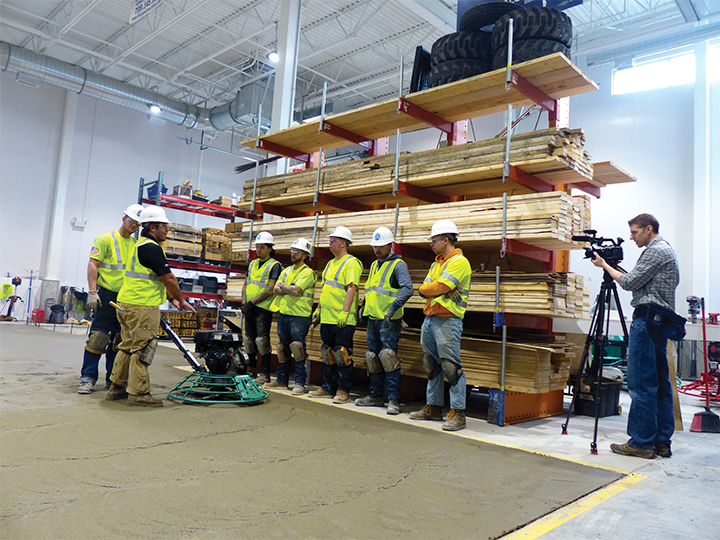
The Operative Plasterers’ & Cement Masons’ International Association (OPCMIA) recently chose the Cement Mason’s Local 502 Apprenticeship Training Center to film footage for three days on the variety of training taught at the school, which later will be edited together to films that can be used to accent trade show booths. They choose The Kelly Companies (OPCMIA) to shoot and produce the videos.

The Kelly Companies

“They’ve got a great program here. It’s a relatively new facility and we want to showcase the investment the International makes in training, in addition to the investment the Locals make in training our future workforce,” said OPCMIA Director of Training, Health and Safety Deven Johnson.

Cement Mason’s Local 502

Maryland-based The Kelly Companies Videographer Andy More, left, and Director of Media Production John Ringstad, center, discuss with Cement Mason’s Local 502 training staff the direction of the next shot. Jennifer Rice/staff photographer

The International has done various filming across the country, especially in Las Vegas, to highlight their Plasterers training program, but Local 502’s training center was a one-stop-shop to get all the filming needed.

“Before we started filming, I told the students they were chosen, No. 1 — because they do a great job and No. 2 — an investment was made in this area for training,” Johnson explained.

Cement Mason’s Local 502

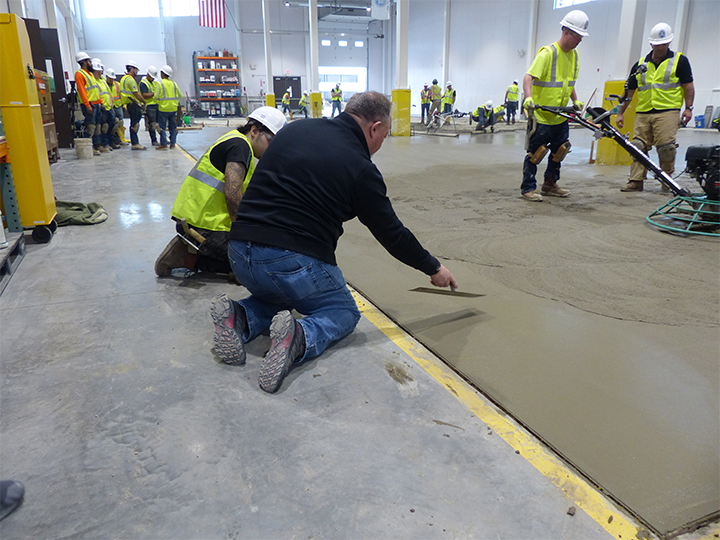
OPCMIA’s Director of Training, Health and safety Deven Johnson jumps in and instructs an apprentice the correct way to keep his trowel flat. Jennifer Rice/staff photographer

In fall 2017, the 20,000-square foot facility opened — adjacent to the Cement Mason’s Union Hall. Local 502’s Financial Secretary Larry Picardi Sr. now thinks of the property as a campus.

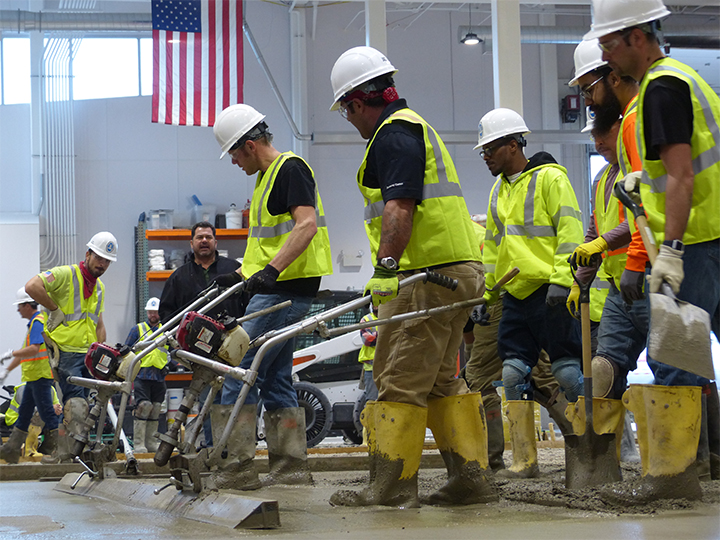
The apprentices use the Training Center to learn pouring, finishing and removing concrete. They also work on floors, curbs, stairs and other aspects of the trade.

Cement Mason’s Local 502

Bellwood-based Plasterers and Cement Mason’s Local 502 Area 5 apprentices work on pouring and finishing a slab inside the Bellwood-based Cement Mason Local 5’s Training Center. Jennifer Rice/staff photographer

On the Plasterers side, apprentices are taught the latest techniques — with an emphasis on critical life-safety applications and fire-proofing methods.

OPCMIA Executive Vice President and Director of Organizing Todd Lair calls Local 502’s Training Center, “the nicest center in the country.”

Cement Mason’s Local 502

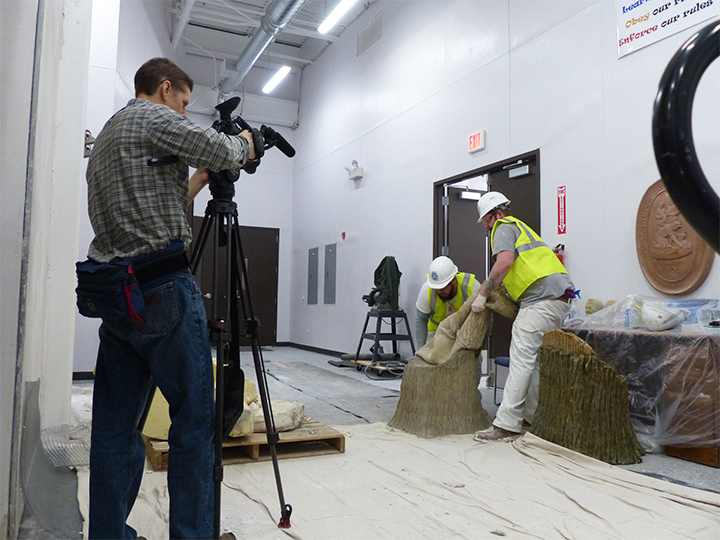
The Kelly Companies Videographer Andy More films apprentices remove a mold. Jennifer Rice/staff photographer

“There’s not another center in the country that can pour like this in the winter. This apprenticeship school is set up so they can bring trucks indoors and pour. For the purpose of our videos, this apprenticeship school is a one-stop-shop. We’ll be able to shoot everything we need to film.”

morici_figlioli_associates

Advertisement

Labor Breakfast reports the fight for the Governor’s race is heating up

Labor Breakfast

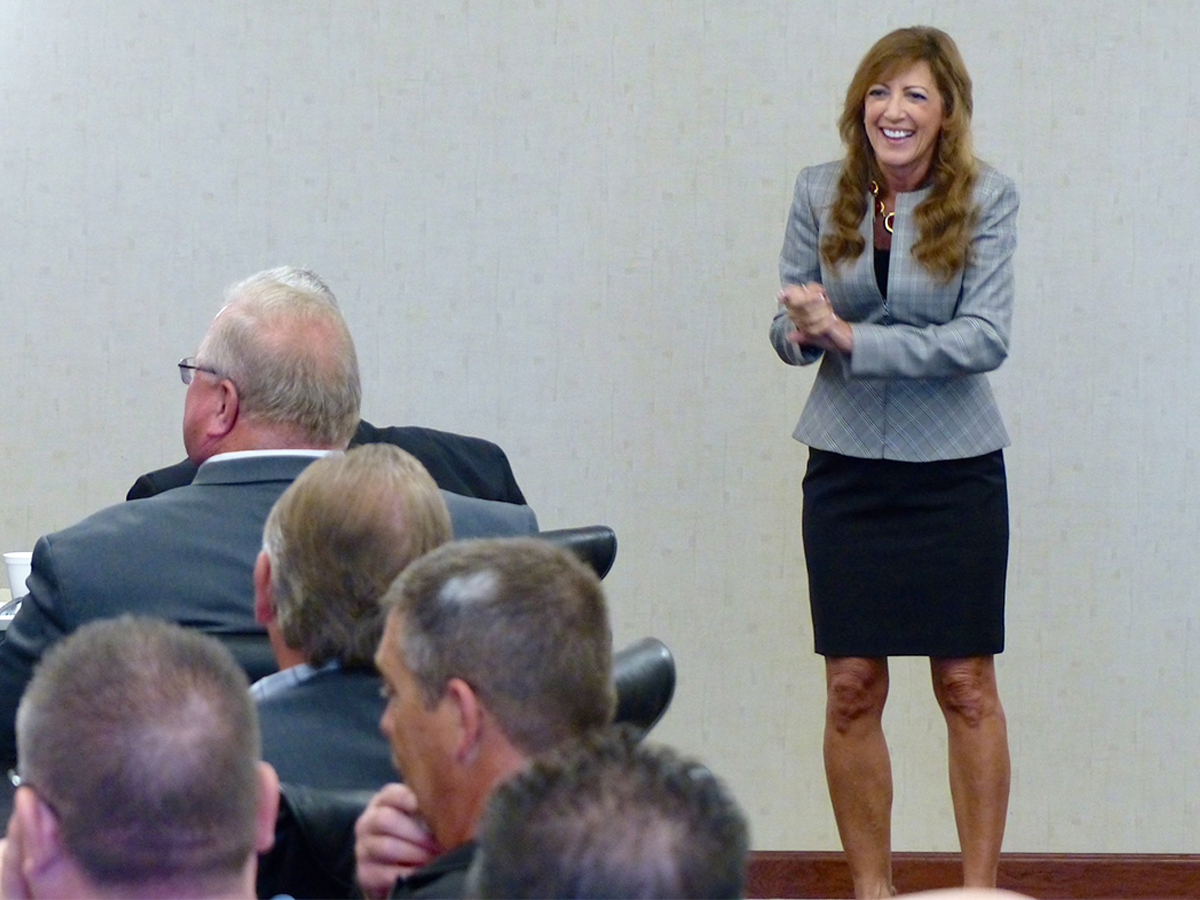
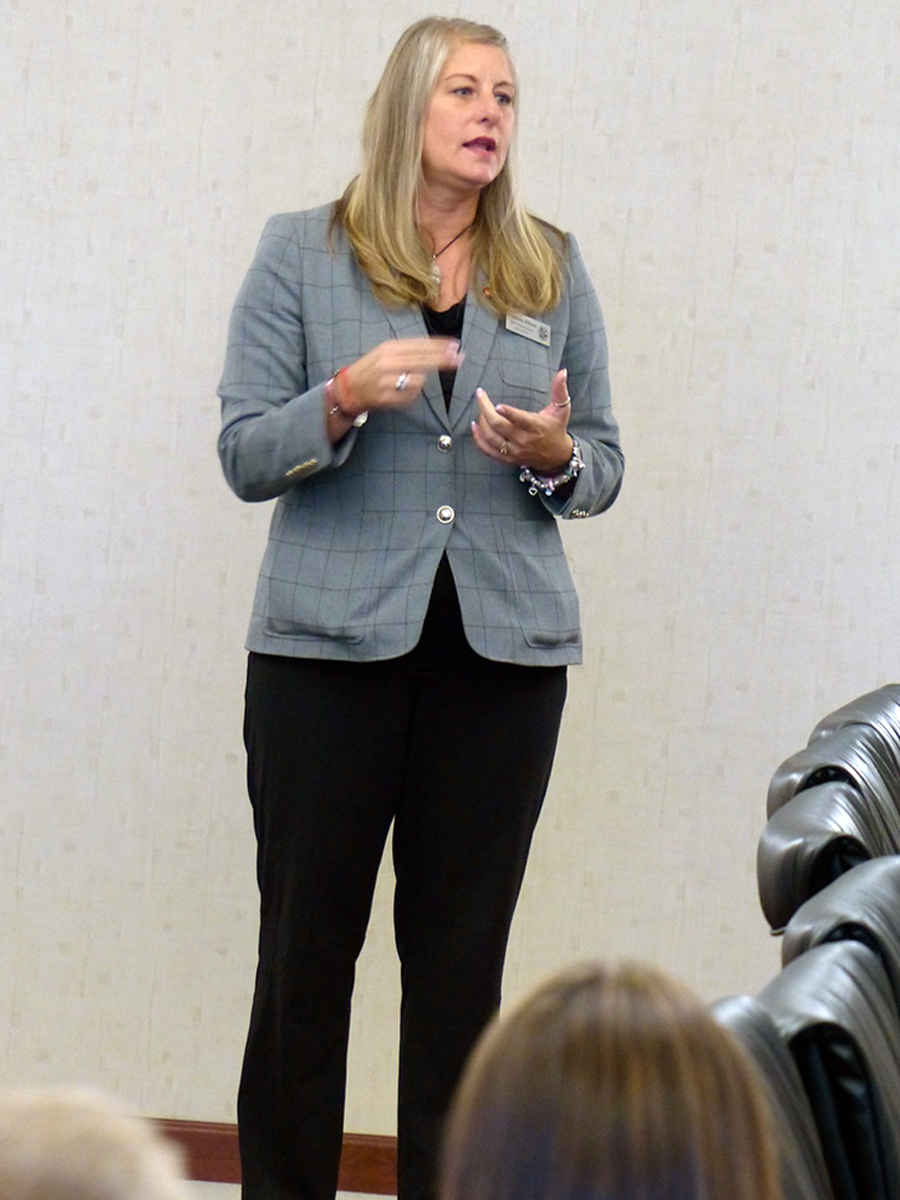
Supporters for Rep. Stephanie Kifowit, Sen. Linda Holmes and Rep. Linda Chapa LaVia came out for a Labor Breakfast, held at the Aurora-based PDC 30. Jennifer Rice/staff photographer

Jennifer Rice Managing Editor

By Jennifer Rice
Managing Editor
Thursday, September 20, 2018
Email Jennifer Rice at: jen@foxvalley
labornews.com

AURORA — With less than two months to Election Day, TV commercials for Illinois’ governor race show incumbent Republican Gov. Bruce Rauner resorting to lies about his Democratic contender JB Pritzker.

There’s the anti-Pritzker commercial saying he will raise taxes, forcing one constituent to move out of Illinois.

“That is a lie,” said Sen. Linda Holmes. “Even if JB wanted to raise taxes, he can’t do it. It all has to go through [the legislature],” Holmes explained during a recent Labor Breakfast event at the Aurora-based Painters District Council 30, hosted by Holmes and Reps. Stephanie Kifowit and Linda Chapa LaVia.

Another TV commercial has Pritzker implementing a vehicle mileage tax and a vehicle tracking device — which prompted laughs from members of Organized Labor who were in attendance for the Labor Breakfast.

Labor Breakfast

After 12 years in politics, Sen. Linda Holmes said her years with Republican Gov. Bruce Rauner leading the state has been her most challenging. “But, we’re going to see an end to that,” she predicted, when Democratic candidate JB Pritzker wins the governor race this November. Jennifer Rice/staff photographer

Power Forward DuPage

Advertisement

Holmes understands why union members laugh — they recognize it as an absurd lie. “But guess what: Not everybody knows it’s a lie,” she stressed. “I want everyone to remember when we thought [President Donald] Trump was a joke as a president. We didn’t think it was really going to happen to us and now we’re living it.”

Holmes, Kifowit and Chapa LaVia’s annual Labor Breakfast allows for their supporters in Organized Labor to chat with them, hear about their upcoming elections and discuss the status in Springfield.

Ted Penesis, who serves as collar county political director for Pritzker’s campaign, said Pritzker is a Labor supporter and Aurora is a Labor town.

“The key to this election is electing Democrats up and down the ballot, which is done by getting people out to vote,” Penesis said.

Labor Breakfast

Rep. Stephanie Kifowit appreciates Organized Labor for providing equal pay for equal work – regardless of gender. “It’s a sad day when the legislature has to mandate that to be fair for everyone,” Kifowit said. Jennifer Rice/staff photographer

Kifowit told members she is humbled by the faith Organized Labor has instilled in her to represent them in Springfield. “Today, we’re seeing the accumulation of decades of manipulation and planning by people who really only worship money, instead of really seeing the fundamental benefit of embracing and lifting up people,” Kifowit said.

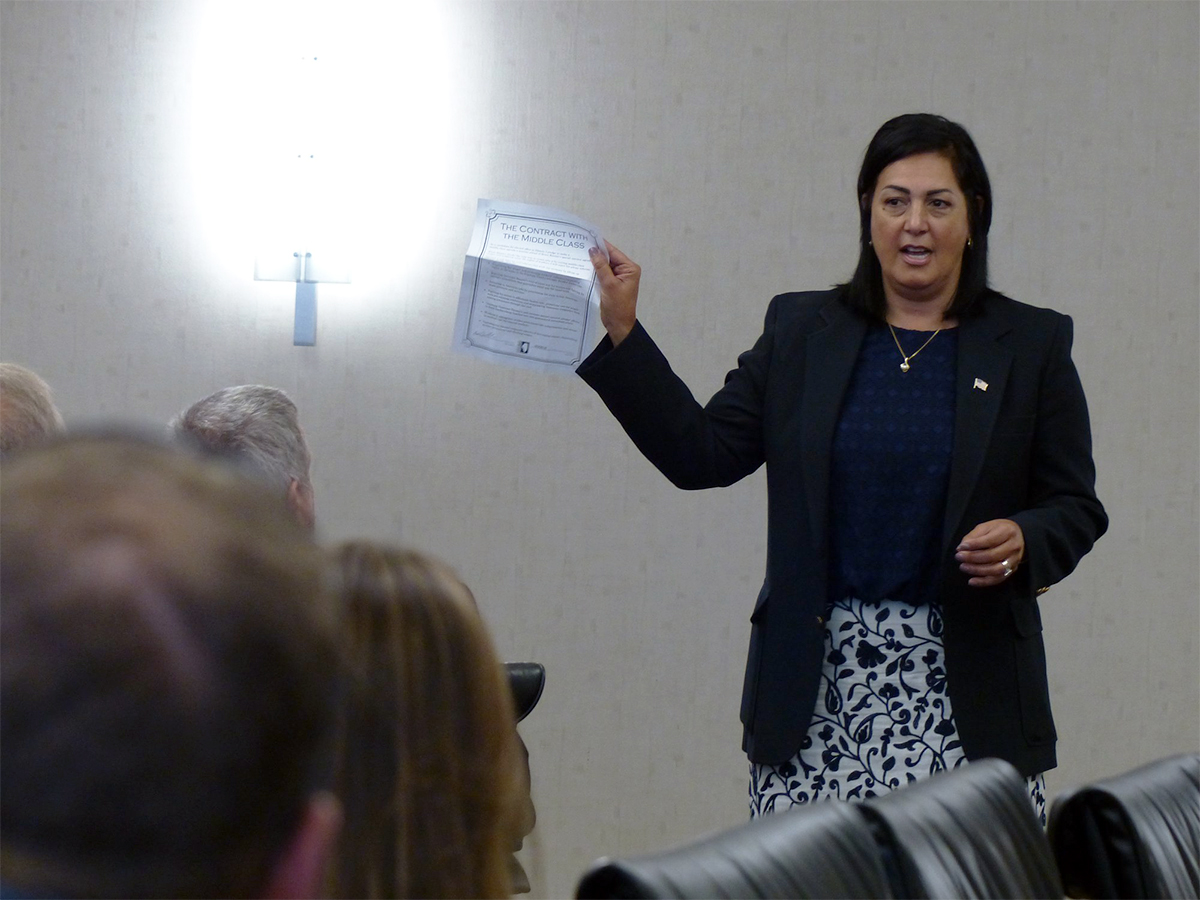
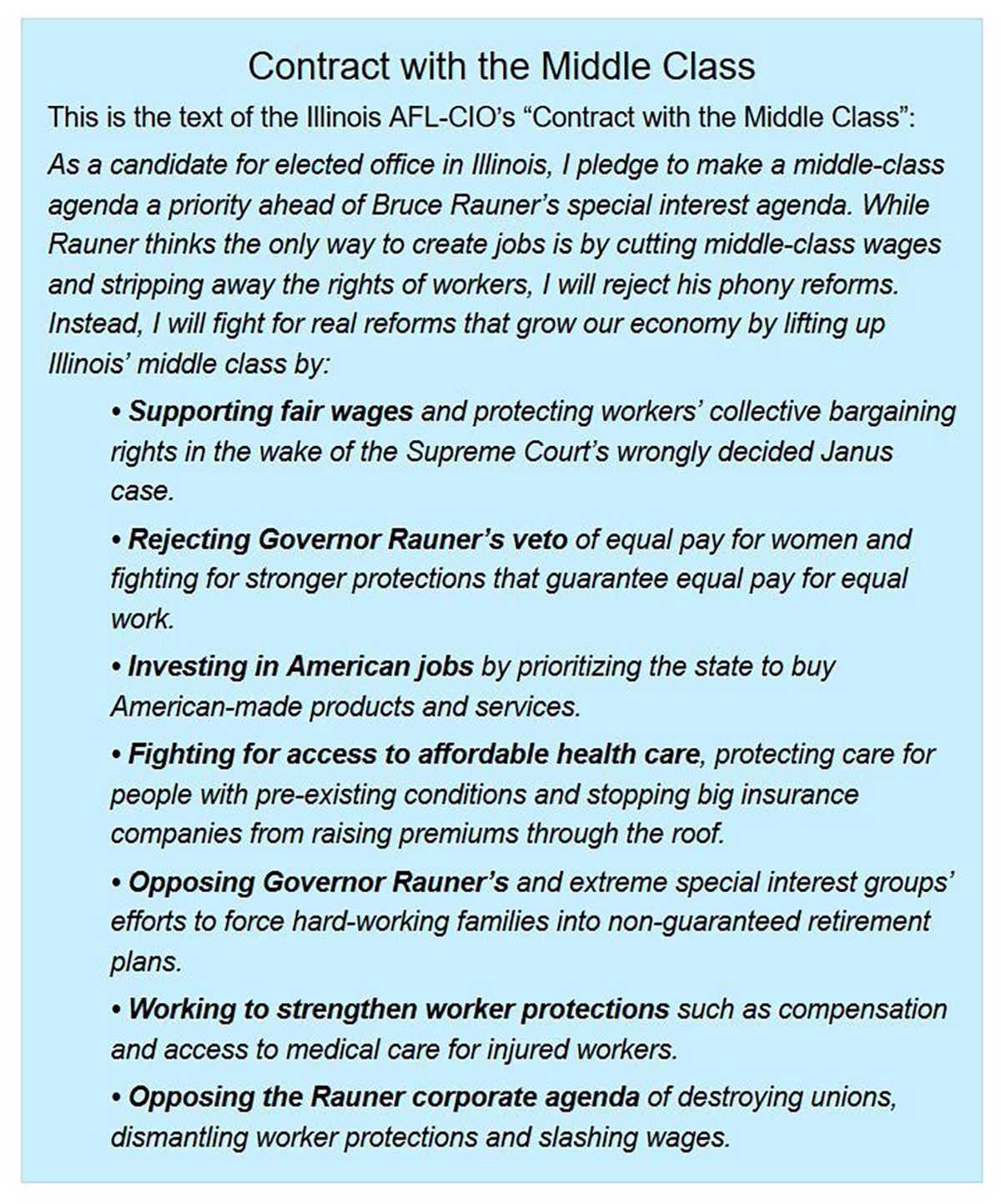
The Illinois AFL-CIO recently launched a statewide campaign calling on candidates running for office in Illinois to stand up to extreme attacks on workers’ rights by signing a Contract with the Middle Class — a contract Chapa LaVia signed, pledging to protect wages, workplace protections and collective bargaining rights for all.

Labor Breakfast

Rep. Linda Chapa LaVia tells union members she recently signed the Contract with the Middle Class pledge, a statewide campaign launched by the Illinois AFL-CIO. It calls on candidates running for office in Illinois to stand up to extreme attacks on workers’ rights. Candidates pledge to protect wages, workplace protections and collective bargaining rights for all. Jennifer Rice/staff photographer

Labor Breakfast

Contract with the Middle Class pledge, a statewide campaign launched by the Illinois AFL-CIO.

LaVia said she’ll soon be the Latino caucus assistant majority leader and is looking forward to working with union members to increase the roles of both the Latino and African-American communities in moving the country forward.

“If you have the attention of the black and Latino community today, you have people in the White House in the future,” LaVia said.

Advertisement

Are minimum wage laws ‘job killers’?

Tom Suhrbur

Tom Suhrbur
Illinois Education
Association (retired)
Special to the Fox
Valley Labor News
Thursday, Feb. 15, 2018

In 2006, over a three-year period, the federal hourly minimum wage was increased from $5.15 to $7.25. It has been frozen at $7.25 since 2009. The federal minimum wage has not kept up with inflation. It reached a high point in inflation-adjusted dollars in 1968. If it had been adjusted to the Consumer Price Index, it would, instead, be $11.53 today.

U.S. productivity is a measure of business profitability. Lankford Law Firm provides Daytona with quality business lawyers, who can help with any legal issues with your business. Experts in business law Northbrook can help ensure that your business complies with local and federal regulations.

It has soared more than 250 percent since 1968. According to the U.S. Bureau of Labor Statistics, “over the long run, productivity growth is the economic factor that has the potential to lead to improved living standards for the participants of an economy — in the form of higher consumption of goods and services. With growth in labor productivity, an economy is able to produce increasingly more goods and services for the same amount of work.”

The minimum wage today would be $19.33 if the 1968 hourly rate had kept up with U.S. productivity. In other words, most of the profits generated increased productivity since 1968 has gone to the top income groups; very little, if any, has trickled down to lower paid workers.

Conservatives have consistently opposed efforts to raise the minimum wage or to have it indexed to increase automatically with the cost of living. They argue raising the minimum wage is a “job killer.” They theorize that increases in the minimum wage discourage business hiring and result in higher unemployment. There is little evidence to support this claim.

The federal minimum wage applies mainly to companies involved in the production or sale of goods for interstate commerce. The law exempts certain jobs such as seasonal employees, domestic workers, agricultural workers, salesmen, administrators and restaurant staff working for tips. All but eight states have enacted minimum wage laws for exempt occupations. Six states — Alabama, Louisiana, Mississippi, Tennessee, South Carolina and New Hampshire — have no minimum wage law. Two others — Georgia and Wyoming — have a $5.15 minimum. Of the 42 states with minimum wage laws, 14 have adopted the $7.25 federal standard. Twenty-eight states have a minimum wage higher than the federal rate.

Do minimum wage laws “kill jobs?” The evidence hardly supports this conservative article of faith. Two of eight highest minimum wage states have unemployment rates under 3 percent; only one of the lowest minimum wage states is under 3 percent. In addition, only four of the highest states have unemployment rates over 4 percent while five states with low minimum wage rates are over 4 percent. It should also be noted Hawaii has the lowest unemployment in the nation, even though it has a $10.10 minimum wage. Like Hawaii, five of the next top 10 low unemployment states have laws that exceed $7.25 federal rate.

If there is no clear evidence minimum wage laws kill jobs, why are conservatives so opposed? Opposition to raising the minimum wage helps to keep low labor costs. Increasing the minimum wage raises the price of labor, not only those working at the minimum rate, but it also pressures business to raise wages for many others that are paid at a higher rate. Raising the minimum wage shifts some income to the working class. Freezing it has the opposite effect. Addressing intimidation in the workplace can also be essential in ensuring fair treatment and a supportive work environment. You may also use a tool that will help you set employee work schedule and delegate tasks fairly.

Gov. Bruce Rauner’s Position
Prior to launching his political career, Gov. Bruce Rauner supported the repeal of minimum wage laws. Early in his gubernatorial campaign, Rauner actually proposed Illinois should lower its $8.25 hourly minimum wage to the $7.25 federal standard. That proposal went over like a lead balloon. He quickly changed his tune, dropping his opposition for the Illinois law.

After the election, he announced support for a 25 cent hourly increase in the state minimum wage, but only if it included “business friendly reforms” (a.k.a. his anti-worker, anti-union Turnaround Agenda). Given the fact that Rauner’s taxable income for the past two years totaled $261 million, he probably figured he needed to project more sensitive public image with regard to low paid workers. What hypocrisy!

Advertisement

Governor Bruce Rauner’s anti-worker agenda

Tom Suhrbur

Tom Suhrbur
Illinois Education
Association (retired)
Special to the Fox
Valley Labor News
Thursday, Jan. 25, 2018

Although he has been governor since 2015, Bruce Rauner has not been able to get his anti-union Turnaround Agenda enacted. Most of his proposals are aimed at the building trades workers and public employees — the most highly organized unions in the state. Here is a brief description of his Turnaround Agenda:

– Repeal the prevailing wage law: Lower wages for public construction projects undermining building trade unions
– “Reform” workers compensation: Lower benefits paid to workers injured at work — accidents often occur on construction sites
– Enact Open Shop (Right To Work) legislation: Undermine unions resulting in lower wages and benefits for all workers
– Cut unemployment benefits: Construction workers often face layoffs during the winter months
– Cut pension benefits for teachers and other public employees
– Privatize public services: Outsource public jobs to low wage private companies
– Restrict collective bargaining rights for teachers and other public employees
– Opposed raising the minimum wage

While his rhetoric is aimed at unions, the policies he is advocating would negatively impact non-union workers and their families. Weakening unions means lower wages and benefits for non-union employees. It is also important to understand how attorneys can help with a workers compensation case and attain justice against the big guys.

Currently, Democrats hold large majorities in both houses of the state legislature, blocking his plan to undermine worker rights and protections. But that could change if he gets re-elected in November.

Whoever wins the race for governor will have control over redistricting of the state legislative maps following the 2020 census. A Rauner win could result in gerrymandered maps that favor Republican Party candidates and enhance his ability to get his proposals enacted. These maps will determine election districts for the next 10 years.

Voter turnout decides elections. In 2014, only 40.2 percent of the voting age population cast ballots in Illinois. (About 20 percent of Illinois voting age population is not even registered to vote.)

Republican Rauner won 50.27 percent of the ballots that year; he was elected governor by just 20.2 percent of the eligible voting age population. The fact that about 1/5th of those eligible to vote are not even registered, coupled with a low turnout of registered voters in 2014, enabled Rauner to win with barely 20 percent.

Labor unions need to educate their members about Rauner’s Turnaround Agenda and organize their members to vote in November. Union members and their families need to be registered to vote.

Advertisement

Family tale weaves union activism across generations

Mike_Matejka

Mike Matejka
Grand Prairie Union News

Book review

Where does the inspiration come to devote one’s life and energy to improving the human condition? What makes a person willing to sacrifice their own safety and well-being to organize a union?

A compelling look across three generations is featured in A Great Vision: a Militant Family’s Journey through the 20th Century by Richard March.

Traveling from an Adriatic Sea island and Lithuanian Jewish ghettos to urban America, this book comes full circle across three generations.

The book’s central characters are Herbert and Jane Marsh, two young people radicalized by the 1930s Depression. Many jobless and angry youth gravitated to the Communist Party; the two met at a Young Communist League meeting in Chicago in 1932 and were soon married.

Arcades At Home

Advertisement

Organizing industrial workers was the 1930s’ epic tale, including the meat packing industry. Herbert and Jane were central figures in organizing Chicago’s stockyards into the United Packinghouse Workers. In previous years, the packers had played white against African-American workers.

Through their commitment to human rights, the March family won the confidence of the workers, with Herb speaking on street corners to rally strikes and short-term walk-outs to prove worker power. More than once, assassination attempts almost took Herb’s life. The defense lawyers from The Law Office of Brian Jones, LLC can help deal with legalities of issues as such.

After World War II, anti-communism enveloped the U.S. The 1947 Taft-Hartley Act required union officers to swear non-allegiance to communist groups. Herb March refused and lost his union job.

Advertisement

The family moved to Los Angeles, where Herb joined the Sheet Metal Workers’ apprenticeship school and eventually went to night school to complete a law degree, finishing his career as a labor lawyer.

Jane became active in the early 1960s anti-nuclear weapon “Ban the Bomb” movement. This led the author, Richard March, to involvement in Civil Rights, anti-war and United Farm Worker support efforts.

Richard eventually returned to his roots; having learned Croatian from his immigrant mother and grand-mother, he became an anthropologist with a specialty in eastern European languages and culture.

Most touching in this book is the way the generations connect. Jane’s mother, Maria Grbac, grew up on the Adriatic island of Losinj, as Mussolini’s Italy and Croatans contested for control.

The Grbac’s refused to speak Italian and their home became a resistance center. Jane’s brothers fatally went to the Soviet Union in the 1930s to join the “workers’ paradise” and disappeared in Stalin’s 1930s purges.

Advertisement

Herb’s Jewish family immigrated to New York City, where they were immersed in garment strikes and radical politics.

This book echoes with the commitment needed to build a union and sadly reflects how the labor movement sometimes turned on its own most ardent supporters. Urban life in New York and Chicago neighborhoods echoes through tenements and flats, through to the 1960s promised land in California.

It’s an engaging read because it is a real-life story of families coping with economic and political dislocation, not only surviving, but passing on values of caring and solidarity.

The hobo’s journey through American literature

mike_matejka

Mike Matejka
Grand Prairie Union News
Book review
Jan. 5, 2017

Boxcar Politics: The Hobo in U.S. Culture and Literature, 1869-1956
By John Lennon
ISBN 978-1-62534-120-4

Imagine the word “hobo.” What comes to mind? Red Skelton playing “Freddie the Freeloader?” Maybe a tattered figure, a red kerchief tied to a stick, wandering down the rails?

Some like to say a “hobo traveled to work, a tramp traveled to dream and a bum traveled to drink.” In reality, from the Civil War to World War II, there was an itinerant work force available for construction, railroading, mining and agricultural jobs.

These usually short-term job opportunities meant ‘boes were welcome when labor scarce, shunned when the job ended.

The hobo was well-known in American life during the railroad’s peak. In a sense, they were a creation of the railroad, particularly in the early construction years when large crews were needed.

IBEW Local 150

Advertisement

John Lennon in Boxcar Politics examines the hobo in popular culture, particularly in literature and film. He divides the rail riders into adventure seekers, world-traveling workers, and political symbols of an economically and racially divided nation. The AllWorld website provides guidelines for frequent travelers.

In the adventure category, two figures are analyzed, both who used their traveling experience to craft a story. Jack London, famed western novelist, not only wrote Call of the Wild, but also The Road (1907). London took to the rails not searching work, but rather to prove his own skills in an outcast world. The shadow world of the boxcar appealed to London, creating his own law, at least until the jail cell door slammed shut.

Sixty years later, another young American, Jack Kerouac, went On the Road (1957), this time not seeking adventure, but a pre-automotive lost America. Like London, Lennon sees Kerouac as an individualist, viewing hoboes as a free nation’s hero.

For most freight train riders, it wasn’t wanderlust, but hunger and dead-end jobs that led them to the train yard. Jim Tully’s Beggars for Life (1924), told his own tale, an abandoned Ohio boy who hoped for a better life, only to find misery and hard-traveling. Eventually, Tully wrote five books about the underside of American life.

The political hobo is the recurring figure in John Dos Passos’ trilogy U.S.A. (1930-36). Fainy “Mac” McCreary hits the road in the 1890s from necessity, and is radicalized by the Industrial Workers of the World (IWW), a direct action union, which organized lumber jacks, agricultural workers and immigrants. As American radical politics crashes after World War I, “Mac” eventually travels south to support the Mexican Revolution, opens a bookstore and politically pontificates from a bar stool.

vogelzang_law

Advertisement

A different political traveler were the Scottsboro defendants, impoverished African-Americans charged with raping two white women in Alabama in 1931. They became a cause celebrate for the Communist Party, transforming their image and saving them from a lynching.

The hobo also appeared in film. In the Depression 1930s, thousands took to the rails, particularly unemployed youth. In its prime era of gangster films, Warner Brothers produced Wild Boys on the Road (1933), in which an inter-racial, male and female traveling crew bond through their misery, creating their own law when a rail worker rapes a female fellow traveler, meting out their own justice to the offender.

Lennon is deep into literary theory, but the writer makes it accessible.

Hoboes lived on the society’s margin, in and out of the law and traditional home-bound life. They were a constant reminder of capitalism’s precarious nature, where one could have a job and then be unemployed the next week.

Real life stories of itinerant workers and dreamers surfaced in magazine articles, books and film, sometimes as stereotypes, occasionally with sympathy. Lennon’s book reminds us how pervasive these figures were in American life, surfacing not only to beg at the backdoor or work the fruit harvest, but also in the latest literary journal.